
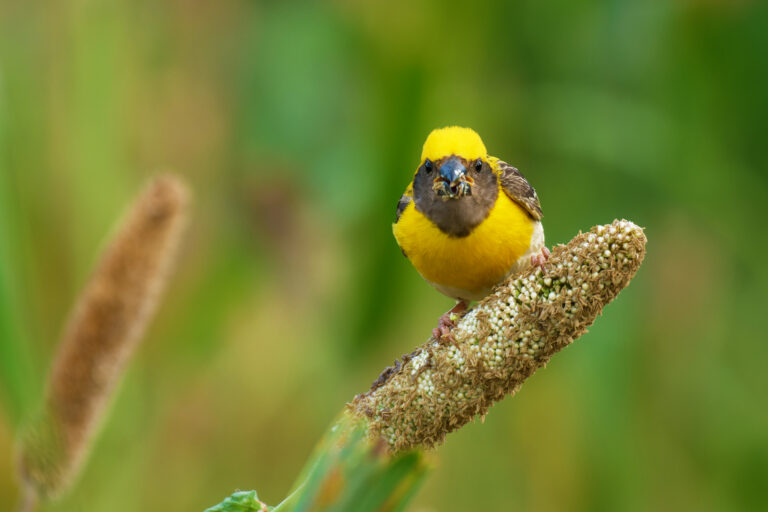
Introduction: The Intricate World of Weaver Birds
Weaver birds, belonging predominantly to the family Ploceidae, are a captivating group of passerine birds renowned for their extraordinary nest-building skills and often vibrant plumage. Found primarily across sub-Saharan Africa, with some species extending into Asia, these birds are a highlight for any birder, from novice to expert. Their presence adds a dynamic element to diverse landscapes, from arid savannas to lush wetlands, and even urban gardens.
This comprehensive guide aims to equip you with the knowledge and practical tips necessary to confidently identify weaver birds in the field, focusing on three primary identification markers: their distinctive nests, their varied coloration, and their preferred habitats. Understanding these features will not only enhance your birding experience but also deepen your appreciation for these remarkable avian architects.
Understanding Weaver Bird Families and Similar Species: A Crucial First Step
Before delving into specific identification techniques, it’s vital to grasp the broader context of weaver birds within the avian world. The family Ploceidae is vast and diverse, encompassing over 100 species. While many share the characteristic weaving behavior, there’s significant variation. Some species, like the Village Weaver (Ploceus cucullatus), are widespread and easily recognizable, while others are more localized and subtle in their distinctions.
It’s also important to differentiate weavers from other bird families that might share similar appearances or habitats. For instance, some species of bishops (genus Euplectes), which are closely related within Ploceidae, can be mistaken for weavers due to their bright breeding plumages, particularly males. However, bishops typically build simpler, cup-shaped nests in dense grass, rather than the elaborate woven structures characteristic of many true weavers.
Similarly, certain finches or sparrows might be superficially similar in size or general coloration, but lack the specialized bill structure for weaving and the complex nest architecture. Always pay attention to the overall body shape, bill size and shape, and most importantly, the presence and style of their nests, as these are often the most reliable differentiators.
For example, a common house sparrow (Passer domesticus) might forage in similar areas to a weaver, but its nest is a messy, unorganized collection of grass and debris in a cavity, not a finely woven, suspended structure.
Nest Construction and Its Significance: Nature’s Master Architects
The nests of weaver birds are arguably their most iconic feature and often the first clue to their identity. These intricate structures are not merely shelters but complex architectural marvels, meticulously woven from strips of grass, leaves, and other plant fibers. The construction process is a testament to the male weaver’s skill, often serving as a display to attract a mate. Different species exhibit distinct nest designs, offering invaluable identification cues.
Types of Weaver Bird Nests: A Spectrum of Designs
While there’s a wide array of nest styles, several common forms stand out:
- Retort-shaped nests: These are perhaps the most classic weaver nests, resembling a flask or retort, with a bulbous main chamber and a downward-pointing entrance tunnel. A prime example is the Southern Masked Weaver (Ploceus velatus), whose males construct these elegant, suspended nests. The entrance tunnel can vary in length and width, providing a subtle species-specific detail. These nests are typically suspended from the tips of branches, often over water or in thorny bushes, offering protection from predators. Observing the length and rigidity of the entrance tunnel can help distinguish between similar species. For instance, the Lesser Masked Weaver (Ploceus intermedius) also builds a retort-shaped nest, but its tunnel is often shorter and less defined than that of the Southern Masked Weaver.
- Globular or Spherical nests with side entrances: Many species build more rounded or oval nests, often with a side entrance that may or may not have a short tunnel. The Village Weaver, a common and widespread species, builds large, somewhat untidy globular nests, often in colonies. The entrance is typically on the underside or side, sometimes with a short spout. These nests can be found in a variety of trees, including palms and acacias, and are often clustered together in conspicuous colonies. The rougher, less refined appearance of the Village Weaver’s nest, compared to the neater structures of some other species, is a key characteristic.
- Pendant nests: Some weavers construct elongated, hanging nests, sometimes quite long, with the entrance at the bottom. These can be more tear-drop shaped or even cylindrical. The Spectacled Weaver (Ploceus ocularis) builds a neat, pear-shaped nest with a short, downward-pointing entrance tube, often suspended from a single branch. Another example is the Golden Weaver (Ploceus subaureus), which constructs a more elongated, somewhat bag-like nest, also suspended from a branch tip. The length and shape of the pendant, as well as the presence and style of the entrance, are important clues.
- Open-topped or simpler nests: While less common for the ‘true’ weavers (Ploceidae), some related species or those with different ecological niches might have simpler nest structures. However, for most species commonly referred to as ‘weaver birds,’ the elaborate woven, enclosed structure is a defining characteristic. If you encounter a simpler, open cup-shaped nest, it’s likely not a weaver, or at least not one of the typical nest-weaving species. For instance, the Red-billed Buffalo Weaver (Bubalornis niger) builds a massive, untidy communal nest of sticks, a stark contrast to the finely woven nests of Ploceus species. This highlights the importance of understanding the broader family distinctions.
Field Tips for Observing Nests: Unlocking Identification Clues
Observing nests requires patience and a keen eye. Here’s how to make the most of your observations:
- Location, Location, Location: Note where the nest is built. Is it high in a tree, low in a bush, over water, or in a reed bed? Some species, like the Cape Weaver (Ploceus capensis), prefer reeds or bulrushes near water, often building their nests over the water for added protection. Others, like the Red-billed Buffalo Weaver (Bubalornis niger), build massive, communal stick nests in large trees, a stark contrast to the typical woven nests. The height from the ground and the type of vegetation used for support are crucial details.
- Material and Weave: Look closely at the materials used. Are they fine grass blades, broader leaf strips, or even palm fronds? The tightness and neatness of the weave can also be indicative. Some nests are meticulously crafted, appearing almost machine-made, while others appear more haphazard and bulky. For example, the African Golden Weaver (Ploceus subaureus) often uses thin, pliable grass stems, resulting in a very neat, compact structure, whereas the Village Weaver’s nest can look quite shaggy.
- Entrance Orientation: Is the entrance at the bottom, side, or does it have a long, downward-pointing tube? This is a critical feature for distinguishing between species. For example, the Southern Masked Weaver’s downward-pointing entrance is quite distinct from the often more lateral entrance of a Village Weaver. Observe if there’s a ‘porch’ or landing platform near the entrance, or if the entrance is simply a hole.
- Colonial vs. Solitary: Are there many nests clustered together, indicating a colonial species like the Village Weaver or Sociable Weaver (Philetairus socius), or is it a solitary nest? The Sociable Weaver builds arguably the most impressive avian structure in the world – a massive, multi-chambered communal nest in a large tree or on a utility pole, housing hundreds of birds. Colonial nesters often create a noisy, bustling environment, making them easier to spot.
- Active or Abandoned: An active nest, with birds flying in and out, or males displaying, provides the best opportunity for identification. Observing the birds interacting with the nest can confirm the species. However, even abandoned nests can offer clues, especially if they are well-preserved. Note if the nest appears freshly built or weathered, which can indicate recent activity.
Always remember to observe from a respectful distance, especially during the breeding season, to avoid disturbing the birds. Binoculars are indispensable for examining nest details without causing distress. A spotting scope can be even more helpful for very distant or high-up nests, allowing for detailed examination of the weave and entrance.
Coloration and Plumage Patterns: A Kaleidoscope of Hues
While nests provide crucial structural clues, the plumage of weaver birds offers a vibrant spectrum of colors and patterns that are equally important for identification. However, weaver plumage can be tricky due to sexual dimorphism (differences between males and females) and seasonal variations, particularly during the breeding season.
Typical Colors and Variations: From Brilliant Yellows to Subdued Browns
Weaver birds display a remarkable range of colors:
- Yellow and Gold Shades: Many of the most iconic weavers are characterized by brilliant yellow or golden plumage, especially the males during breeding season. Species like the Golden Weaver (Ploceus subaureus) and the Cape Weaver are prime examples, often featuring bright yellow bodies contrasted with darker facial masks or wings. The intensity and distribution of yellow can vary. For instance, the male Eastern Golden Weaver (Ploceus subaureus aureoflavus) is almost entirely golden yellow, while the Cape Weaver has a more olive-yellow back and a chestnut wash on its chest.
- Black and Brown: A significant number of weaver species incorporate black and brown into their plumage. The Black Weaver (Ploceus nigerrimus) is predominantly black, while many females and non-breeding males of yellow species will have more subdued, streaky brown and buff plumages. The amount of black on the head or chest can be a key identifier. For instance, the male Southern Masked Weaver (Ploceus velatus) has a distinctive black mask covering its face and throat, contrasting sharply with its yellow body, whereas the Village Weaver (Ploceus cucullatus) male has a black face and throat, but also a chestnut wash on its nape.
- Greenish or Iridescent Tints: Some species exhibit greenish or olive tones, often with a subtle iridescence. The Spectacled Weaver (Ploceus ocularis), for example, has an olive-green back and yellow underparts, with a distinctive black eye-stripe that gives it its name. These more muted colors can blend well with foliage, making them harder to spot, but their specific patterns are diagnostic. The Olive-headed Weaver (Ploceus olivaceiceps) is another example, with a striking olive head and yellow body.
- Red and Orange: While less common for the ‘true’ weavers (Ploceidae), some related species like the Red-headed Weaver (Anaplectes rubriceps) or the bishops (e.g., Southern Red Bishop, Euplectes orix) display striking reds and oranges, particularly in breeding males. These vibrant colors are often used in courtship displays. The Red-headed Weaver, for instance, has a brilliant red head and chest contrasting with a yellow body and black wings, making it unmistakable.
Field Identification Tips for Plumage: Navigating the Nuances
Identifying weavers by plumage requires careful observation and an understanding of their life cycles:
- Sexual Dimorphism: Always consider whether you are observing a male or female. In many species, males are significantly brighter and more patterned during the breeding season, while females and juveniles are often duller, streaky brown, and can be very difficult to distinguish from each other or from other small brown birds. For example, a female Village Weaver looks very different from a breeding male; she is typically dull olive-brown above and paler below, with streaking. If you see a drab bird near a vibrant yellow male, it’s highly likely to be the female of that species.
- Seasonal Variation: Many male weavers undergo a dramatic molt from a dull, eclipse (non-breeding) plumage to a vibrant breeding plumage. The timing of your observation will greatly influence what you see. The breeding season, typically coinciding with the rainy season in many African regions, is when males are at their most colorful and active. During the non-breeding season, a male Southern Masked Weaver, for instance, loses its black mask and becomes a duller yellow-green, making it resemble a female or juvenile.
- Key Markings: Look for specific markings. Is there a black mask, a cap, a bib, or streaking on the chest or back? The color of the bill can also be a useful field mark; some weavers have black bills (e.g., Southern Masked Weaver), while others have horn-colored or reddish bills (e.g., Red-billed Quelea, Quelea quelea). Eye color (red, brown, pale) can also be diagnostic. For example, the Lesser Masked Weaver (Ploceus intermedius) is very similar to the Southern Masked Weaver but has a smaller black mask that doesn’t extend as far onto the crown, and often a pale eye compared to the Southern Masked Weaver’s red eye.
- Behavioral Cues: Plumage is often linked to behavior. Brightly colored males will be actively displaying, singing, and constructing nests, making them easier to spot and identify. Observing a male weaving a specific type of nest is a strong indicator of its identity, even if its plumage is slightly ambiguous. Females, while duller, will often be seen inspecting nests or feeding young.
- Lighting Conditions: The quality of light can dramatically affect how colors appear. Observe the bird from different angles if possible, and be aware that strong sunlight can wash out colors, while shade can deepen them. Overcast days can sometimes offer the best conditions for true color observation.
It’s often best to combine plumage observations with nest characteristics and habitat information for a conclusive identification, especially for females and non-breeding birds. A single feature, like ‘yellow plumage,’ is rarely enough for a definitive ID in a family as diverse as weavers.
Habitat Preferences and Range: Where to Find Them
Understanding the preferred habitats and geographical distribution of weaver birds is a fundamental aspect of identification. Birds are intrinsically linked to their environment, and knowing where a species is likely to occur can significantly narrow down possibilities.
Typical Weaver Bird Habitats: Diverse Ecosystems
Weaver birds are highly adaptable and occupy a wide array of habitats across their range:
- Riverine Forests and Wetlands: Many species, such as the African Golden Weaver (Ploceus aurantius) and various bishop species, thrive in areas with abundant water. Reed beds, papyrus swamps, and trees along riverbanks provide both nesting materials and insect prey. The dense vegetation offers cover and protection. For example, the Golden Bishop (Euplectes afer) is almost exclusively found in wet grasslands and marshes, building its nest low in dense vegetation.
- Grasslands with Scattered Trees and Shrubs: This is a classic weaver habitat. The open grasslands provide foraging opportunities, while scattered trees (like acacias) and shrubs offer ideal nesting sites. The Village Weaver and Southern Masked Weaver are commonly found in such environments, often forming large breeding colonies. These species are highly adaptable and can persist even in fragmented habitats.
- Savannas and Arid Regions: Some species, like the Sociable Weaver, are adapted to drier, more open savannas, where they build their colossal communal nests in large trees or even on man-made structures like telephone poles. The Red-billed Buffalo Weaver also prefers arid savannas and thornveld, often nesting in large acacia trees. These species have evolved specific adaptations to cope with harsher, drier conditions.
- Farmlands, Gardens, and Urban Areas: Many weaver species are highly commensal with humans, readily adapting to modified landscapes. They can be found in agricultural fields, suburban gardens, and even city parks, utilizing ornamental trees for nesting and feeding on cultivated grains or insects attracted to gardens. The Cape Weaver is a common sight in gardens across South Africa, often nesting in exotic trees. The Village Weaver is also a frequent visitor to human settlements.
- Forest Edges and Woodlands: While not typically deep forest dwellers, some weavers prefer the edges of forests or open woodlands, where they can find a mix of dense cover and open foraging areas. The Spectacled Weaver is often found in forest edges and dense bush, where its olive-green plumage provides excellent camouflage. The Black-necked Weaver (Ploceus nigricollis) is another forest-edge specialist, often found in the canopy.
Range and Distribution: Knowing Your Geography
The geographical range of a weaver species is a critical identification factor. While many species are widespread across sub-Saharan Africa, others have much more restricted distributions. For example:
- The Village Weaver is one of the most widespread weaver species, found across much of sub-Saharan Africa, from Senegal in the west to Ethiopia in the east, and south to South Africa.
- The Southern Masked Weaver is prevalent in southern Africa, including South Africa, Namibia, Botswana, and Zimbabwe, extending north into parts of Angola and Zambia.
- The Cape Weaver is endemic to South Africa and Eswatini (formerly Swaziland), making its presence a strong indicator of these specific regions.
- The Speke’s Weaver (Ploceus spekei) is found primarily in East Africa, particularly in Ethiopia, Somalia, Kenya, and Tanzania. Its range does not overlap significantly with the Southern Masked Weaver.
- The Jackson’s Golden-backed Weaver (Ploceus jacksoni) is restricted to specific wetland areas in East Africa, such as the papyrus swamps of Uganda and western Kenya.
Always consult a reliable regional field guide or online resources like eBird for up-to-date range maps. If you are birding in Kenya, for example, you would focus on species known to occur there, rather than those endemic to South Africa. This geographical filtering can significantly narrow down the potential species you are observing.
It’s also important to note that climate change and habitat alteration can sometimes lead to range shifts, so staying updated with local birding communities can be beneficial.
Practical Birding Advice: Enhancing Your Field Skills
Successful weaver bird identification relies on a combination of careful observation, patience, and the effective use of resources. Here are some practical tips to refine your birding skills:
- Observe from a Distance: Always maintain a respectful distance from birds, especially near nests. This minimizes disturbance and allows you to observe natural behaviors. Binoculars are essential for detailed observation without intrusion. A good pair of 8×42 or 10×42 binoculars will bring distant details into sharp focus, allowing you to discern bill color, eye color, and subtle plumage patterns.
- Patience is Key: Birds, especially small passerines like weavers, can be fast-moving and elusive. Spend time quietly observing. Often, a bird will reveal more identifying features or behaviors if you wait patiently. Sit still and let the birds get used to your presence; they will often resume their natural activities.
- Note Multiple Features: Don’t rely on a single characteristic. Combine observations of nest type, plumage (male/female, breeding/non-breeding), bill color, leg color, size, shape, and behavior. For instance, a bright yellow bird in a thorny bush with a retort-shaped nest and a black mask is almost certainly a Southern Masked Weaver in southern Africa. If it’s building a shaggy, globular nest in a palm tree, it’s more likely a Village Weaver.
- Use a Field Guide: A good quality regional field guide is your best friend. It will provide illustrations or photographs, detailed descriptions of plumage, calls, nests, habitat preferences, and range maps for all local species. Pay attention to the subtle differences highlighted in the guide, especially in sections comparing similar species. Always carry it with you and refer to it frequently.
- Listen to Calls: Weaver birds have a variety of calls and songs, which can be highly diagnostic. Many species have chattering, buzzing, or whistling calls. Learning these vocalizations can help you locate and identify birds even when they are hidden in dense foliage. The distinctive, often noisy chattering of a Village Weaver colony, for example, is unmistakable. Apps like Merlin Bird ID can help identify calls in real-time, but always cross-reference with your field guide or known recordings.
- Take Field Notes and Photos: Jot down observations in a notebook or use your phone to take photos or videos. Even blurry photos can sometimes capture enough detail to aid in identification later. Note the date, time, location, habitat, and specific features you observed. Describe the bird’s size relative to a common bird (e.g., ‘sparrow-sized’), its overall shape, and any distinctive movements or behaviors.
- Consult Online Resources: Websites like eBird, Audubon, and the Cornell Lab of Ornithology offer vast databases of bird information, including photos, sound recordings, and detailed species accounts. These can be invaluable for confirming identifications or learning more about specific species. Regional birding forums or Facebook groups can also be helpful for local expertise, where you can share your observations and ask for help from experienced birders.
- Birding with Experienced Birders: Joining a local birding group or going out with an experienced birder can accelerate your learning process. They can point out subtle features and share their knowledge of local species, including common pitfalls and unique local variations.
Identification Cautions: Avoiding Common Pitfalls
Even seasoned birders can make identification errors, and weavers present their own set of challenges. Being aware of common pitfalls can help you avoid misidentifications:
- Sexual and Seasonal Dimorphism: As mentioned, male and female weavers, and breeding vs. non-breeding plumages, can look dramatically different. A drab, streaky brown bird might be a female of a species whose male is brilliantly yellow. Always consider the possibility of different plumages and use your field guide to understand the full range of appearances for each species. Forgetting this is a very common mistake.
- Juvenile Plumage: Young weavers often have distinct juvenile plumages that differ from both adult males and females. These can be particularly confusing. They typically resemble females but might have softer, less defined markings, and often a paler bill. Observe their behavior; juveniles might be seen begging for food from adults.
- Hybridization: While less common, some weaver species can hybridize, leading to individuals with mixed features that don’t perfectly match any single species description. This is a rare but possible complication, especially in areas where ranges overlap. If a bird’s features seem to defy classification, hybridization might be a consideration, though it’s often a last resort for identification.
- Lighting and Distance: Poor lighting conditions, glare, or excessive distance can obscure crucial details, leading to misinterpretation of colors or patterns. A yellow bird in harsh sunlight might appear washed out, or a black mask might seem less defined. Always try to get a clear, unobstructed view and observe in good light.
- Similar Species: Be mindful of other bird families that might superficially resemble weavers, such as certain finches, sparrows, or even some warblers, especially in their non-breeding plumages. For example, some female bishops can look very similar to female weavers. Always cross-reference with multiple features, especially bill shape and size, which are often distinct.
- Over-reliance on a Single Feature: Never identify a bird based on just one characteristic. A yellow bird isn’t automatically a weaver; a hanging nest isn’t always a weaver’s. Look for a combination of features that collectively point to a specific species. For instance, a yellow bird with a black mask, building a retort-shaped nest, in a specific region, provides a much stronger identification than just ‘yellow bird.’
- Disturbance: Never approach a nest too closely, especially during breeding season. Disturbance can cause parents to abandon their nests, leaving eggs or chicks vulnerable. Observe from a distance with optics.
Sources and Further Reading
- Cornell Lab of Ornithology: All About Birds
- eBird: A Global Database of Bird Observations
- Audubon Society: Guide to North American Birds (While focused on North America, their general birding resources are excellent)
- RSPB (Royal Society for the Protection of Birds): Bird Identification (Focuses on UK birds but offers general ID principles)
- Fry, C. Hilary, and Stuart Keith. The Birds of Africa, Volume VII: Sparrows to Buntings. Academic Press, 2004. (A comprehensive academic resource for African birds, including Ploceidae)
- Sinclair, Ian, and Peter Ryan. Sasol Birds of Southern Africa. Struik Nature, 2020. (An excellent regional field guide for southern Africa)
- Zimmerman, Dale A., Donald A. Turner, and David J. Pearson. Birds of Kenya and Northern Tanzania. Princeton University Press, 1999. (A definitive guide for East African birding)
- Craig, Adrian J. F. K. and C. J. Feare (2020). Weavers (Ploceidae), version 1.0. In Birds of the World (J. del Hoyo, A. Elliott, J. Sargatal, D. A. Christie, and E. de Juana, Editors). Cornell Lab of Ornithology, Ithaca, NY, USA.
Conclusion: A Rewarding Journey into Weaver Bird Identification
Identifying weaver birds is a truly rewarding aspect of birding, offering a unique blend of architectural appreciation, ecological insight, and the thrill of discovery. By systematically observing their extraordinary nests, discerning the nuances of their often-vibrant plumage, and understanding their preferred habitats, birders of all experience levels can confidently identify these fascinating avian builders.
Remember to approach each observation with patience and a keen eye for detail, utilizing the wealth of resources available, from field guides to online databases. Most importantly, always observe responsibly, respecting the birds and their delicate ecosystems. As you hone your identification skills, you’ll not only deepen your appreciation for weaver birds but also contribute to a greater understanding of the rich avian biodiversity found across Africa and beyond. Happy birding!
Featured image: licensed image via Wikimedia Commons. Credit: Rhododendrites. License: CC BY-SA 4.0. Used with attribution.
