
Introduction: Unlocking the Secrets of Phoebe Identification
For bird enthusiasts new to birding, correctly identifying species can be both a challenge and a reward. Among the more accessible and distinctive groups of North American birds are the phoebes, a genus of flycatchers known for their characteristic tail flicking, unique vocalizations, and specific nesting behaviors.
This guide aims to equip birders of all levels with practical tips to confidently recognize phoebe species in the field. We will cover their behavioral cues, subtle physical traits, and habitat preferences, so you can distinguish these fascinating birds from their look-alikes.
Understanding Phoebe Birds: An Overview of the Genus Sayornis
Phoebes belong to the family Tyrannidae, a vast group of New World flycatchers. In North America, the most common species are the Eastern Phoebe (Sayornis phoebe), the Black Phoebe (Sayornis nigricans), and the Say’s Phoebe (Sayornis saya). While the term ‘Western Phoebe’ is sometimes used informally, it typically refers to the Black Phoebe, so it is best to stick to the specific species names.
These birds are primarily insectivores, catching flying insects in mid-air using a ‘sallying’ technique: darting out from a perch to snatch prey and then returning. This foraging strategy is a hallmark of many flycatchers. Phoebes are generally small to medium-sized songbirds, measuring between 6 to 7 inches in length with a wingspan of about 10 to 11 inches, and they often perch in a relatively upright posture.
Tail Movement: The Signature Phoebe Flick
One of the most conspicuous and reliable behaviors for identifying phoebes is their habitual tail flicking. When perched on a branch, fence post, or building ledge, phoebes frequently pump their tails downwards and then slowly raise them back up. This rhythmic motion is a deliberate, almost constant behavior that sets them apart from many other small songbirds. It serves multiple functions, including communication, maintaining balance, and potentially startling insects into flight.
Pay close attention to the rhythm and frequency of these flicks. Phoebes flick their tails sharply and repeatedly, often with a slight pause at the bottom of the downward stroke before a slower return. The motion is particularly pronounced when the bird is alert or agitated. During foraging, flicks may be synchronized with sallies after insects, but the motion is often observed even at rest.
Practical Observation Tip: When you spot a small, dull-colored bird that appears to be a flycatcher, observe it for at least 30 seconds. If you see the consistent, slow-down, quick-up tail flick, you are very likely looking at a phoebe. This single behavioral cue can narrow down your identification before you even consider plumage or calls.
Listening for Distinctive Calls: The Vocal Signatures
Calls are often the most reliable identification tool, especially when visual confirmation is difficult due to dense foliage, poor lighting, or distance. Phoebes produce a series of clear, emphatic phrases that are distinctive within their habitats. Learning these vocalizations is paramount, as they are often heard before the bird is seen.
- Eastern Phoebe (Sayornis phoebe): Renowned for its namesake call, a clear, raspy “fee-bee” or “fee-b-be-o” repeated rhythmically, with the first syllable higher and accented. They also give a soft, descending “chip.” During breeding season they sing persistently from dawn to dusk.
- Black Phoebe (Sayornis nigricans): Its call is a sharp, insistent “chip” or “tseep,” often repeated. The song is a series of clear, descending whistles, described as “tsee-tsee-tseet-tsew,” delivered with a rapid, staccato rhythm.
- Say’s Phoebe (Sayornis saya): Has a plaintive “pee-eer” or “pwee-oo” call, softer and more drawn out than the Eastern Phoebe’s, plus a sharp “pip” that lacks the Black Phoebe’s urgency. Its song is a simple, repetitive two-note phrase.
Listen for these calls during the breeding season (spring and early summer), when they are most prominent for territorial defense and attracting mates. Using a bird call library on a smartphone app can help match the call to the species. Be aware that individual birds may have slight variations in their calls.
Practical Observation Tip: If you hear a distinctive call but cannot see the bird, move slowly and listen for changes in volume to triangulate its position. Once located, look for the characteristic tail flick to confirm it is a phoebe before identifying the species by plumage.
Nesting Habits: Architectural Clues for Identification
Phoebes are well-known for their distinctive nests, built in sheltered, semi-open locations. The nests are cup-shaped and constructed primarily from mud, reinforced with moss, twigs, and plant fibers, often with bits of gravel, hair, or spider silk to bind the structure. Unlike many songbirds that hide their nests, phoebes often choose visible yet protected sites.
- Eastern Phoebe: Famous for nesting on human-made structures: under bridges, on building ledges, under eaves, in culverts, and on rock ledges. They often reuse nests or build near old sites, favoring structures with an overhang that protects the nest from rain and predators.
- Black Phoebe: Also favors bridges, culverts, and buildings, especially near water. Nests are often placed on vertical surfaces, adhering to a wall or rock face, frequently above a pond or stream.
- Say’s Phoebe: Associated with open, arid landscapes. Nests are found on cliff faces, under rock overhangs, in abandoned buildings, or under bridges in rural, open country, and are less likely in suburban backyards.
Observing a nesting site provides strong clues to species identity, especially combined with other observations. Always exercise caution and maintain a respectful distance from active nests so you do not disturb the birds.
Physical Characteristics: Subtle Plumage Differences
Phoebes are generally drab in coloration, often described as ‘plain,’ which can make visual identification challenging without behavioral cues. However, a careful look reveals key distinctions.
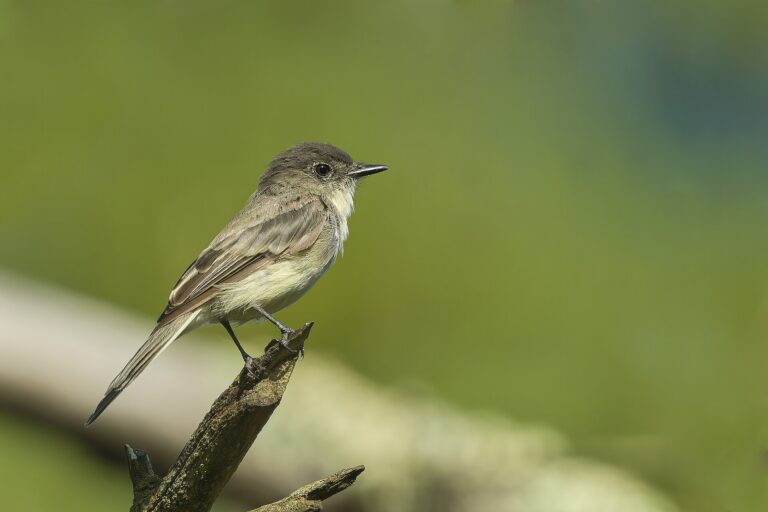
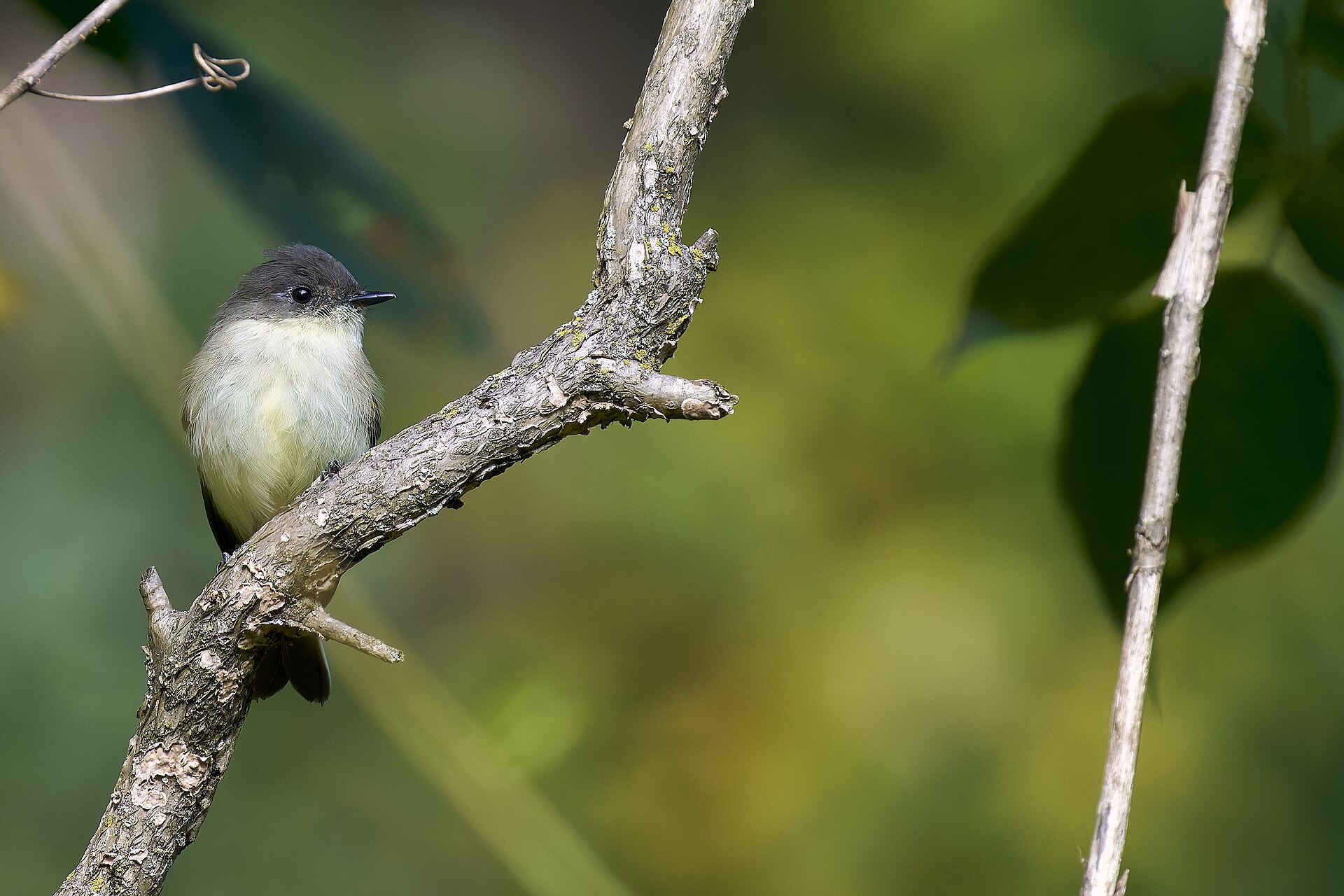
- Eastern Phoebe: Grayish-brown on the back, head, and breast, with a whitish belly. It lacks prominent wing bars or eye rings, contributing to a plain appearance, sometimes with a faint yellowish wash on the flanks in fresh plumage. The bill is short and dark.
- Black Phoebe: Distinctively dark, almost sooty black on the head, back, and upper breast, contrasting sharply with a pure white belly. This striking black-and-white pattern makes it the easiest phoebe to identify visually.
- Say’s Phoebe: Grayish-brown head and back with a distinctive rusty or cinnamon belly and flanks. This rusty wash is a key field mark, though its intensity can vary. They also tend to have slightly longer tails and a larger bill than Eastern Phoebes.
Identification Caution: Plumage can vary with age, wear, and lighting. Juvenile birds may show faint wing bars that fade with their first molt. Always use plumage as a secondary identifier after observing behavior and listening to calls, and be sure lighting is good for discerning subtle color variations.
Habitat Preferences: Where to Find Each Phoebe
Each phoebe species tends to prefer specific environments, so habitat can help narrow down possibilities. Understanding these preferences assists in predicting which phoebe you are likely to encounter.
- Eastern Phoebe: Highly adaptable, often found near water (streams, rivers, ponds) in woodlands, forests, and suburban areas, especially where human-made structures offer nesting sites. Its range spans eastern North America, from Canada to the southeastern U.S.
- Black Phoebe: A bird of western North America strongly associated with water: streams, rivers, ponds, and even irrigated areas and gardens with a water source nearby. Often seen perched on rocks at the water’s edge, dipping down to catch insects.
- Say’s Phoebe: Prefers open, arid, semi-arid landscapes of western North America: deserts, grasslands, sagebrush plains, rocky canyons, and agricultural fields. Less dependent on water than the Black Phoebe, often perched prominently in wide-open spaces.
Practical Observation Tip: When birding in a new area, consult a regional field guide or eBird to see which phoebe species are expected in that habitat and location. A black-and-white bird in an Arizona desert is almost certainly not a Black Phoebe unless it is right by a rare water source.
Practical Field-Identification Tips for Success
To identify phoebes effectively, integrate all the information discussed. Here is a summary of practical tips:
- Observe Tail Movement First: Look for the characteristic downward flick and slow return when perched. If you see it, you have likely found a phoebe.
- Listen for the Call: A distinctive “fee-bee,” “chip-tseep,” or “pee-eer” from a flycatcher-like bird is a strong clue. Use a birding app to compare calls if unsure.
- Note the Nesting Site: In breeding season, a mud-cup nest on a bridge, building, or cliff face is a strong clue. Observe from a distance.
- Consider the Habitat: Is it a wooded eastern stream, a desert canyon, or a California pond? This narrows down the species.
- Examine Plumage (Last Resort): After behavioral and vocal cues, look for the plain gray-white Eastern, the black-and-white Black, or the rusty-bellied Say’s.
- Patience and Persistence: Identification takes practice. Do not get discouraged; enjoy the process and the incremental improvement.
- Use Binoculars Wisely: Observe overall behavior with the naked eye first, then zoom in for details.
- Document Your Observations: Keep a field journal with date, time, location, habitat, behavior, calls, and plumage.
For visual references, reputable sources like eBird or Audubon are invaluable. Always cross-reference multiple sources when unsure.
Comparing Phoebes with Similar Birds: Avoiding Misidentification
Phoebes can sometimes be confused with other flycatchers or small songbirds in challenging viewing conditions. Knowing their common look-alikes prevents misidentification.
- Empidonax Flycatchers: This genus (Willow Flycatcher, Least Flycatcher, Western Wood-Pewee) is notoriously difficult. They are similar in size and often share habitats, but they generally do not exhibit the constant tail flicking of phoebes. Their calls are very different, and they typically have more prominent eye-rings and wing bars, which phoebes lack.
- Eastern Kingbird: A distant kingbird can resemble a phoebe with its dark back and light belly, but kingbirds have a more upright posture, a black head, white underparts, and a prominent white band at the tip of the tail, plus a harsher, buzzing call.
- Swallows: Some perched swallows might be briefly confused, but swallows are sleeker with longer, pointed wings, do not exhibit the tail flick, and fly with much more continuous, agile motion.
- Say’s Phoebe vs. Eastern Phoebe: The key is the rusty wash on the Say’s Phoebe’s belly, absent in the Eastern. In the western U.S., a plain gray-brown phoebe is more likely a Say’s or a juvenile; confirm with call and habitat.
The key differentiators always return to tail movement, call, and nesting habits, which are more reliable than plumage alone. When in doubt, gather multiple pieces of evidence before settling on an identification.
Conclusion: The Art of Phoebe Identification
Identifying phoebes in the field relies on keen observation of behavioral cues, especially their signature tail flicking, distinctive vocalizations, and characteristic nesting sites, along with subtle physical traits and habitat preferences. By paying attention to these integrated clues, birders can significantly improve their identification skills. Patience and practice are essential to successful birding.
The more you observe and listen, the more adept you will become at distinguishing these delightful birds from their neighbors. Combining behavioral observations with visual cues will yield the most accurate results, and soon you will be identifying phoebes with confidence.
