
The Enigmatic Tail Flick: Unraveling the Secrets of Phoebe Behavior
For anyone who has spent time observing the subtle ballet of nature, the phoebe presents a particularly captivating spectacle. These unassuming flycatchers, often found near human habitation, possess a distinctive trait that sets them apart: their incessant tail flicking. This rapid, almost rhythmic movement is not merely a quirky habit; it is a complex, multi-functional behavior that offers a window into the intricate world of avian communication and survival.
Is it a sign of alertness, a territorial declaration, or perhaps a subtle courtship dance? As we will explore, the answer is often all of the above, depending on the specific circumstances. By understanding this characteristic behavior, we can gain a richer appreciation for the intelligence and adaptability of phoebes and enhance our overall birding experience.
Understanding Phoebe Behavior: The Contextual Tapestry of Tail Flicking
Defining the Tail Flick: More Than Just a Movement
At its core, tail flicking in phoebes involves the rapid, repeated upward and downward movements of the tail. These movements are often subtle, a gentle twitch, but can become quite pronounced and vigorous depending on context. Unlike the deliberate tail pumping seen in some other species, the phoebe’s flick is typically quick, almost a snap, and often seems involuntary.
It is a behavior observed across various scenarios: when a phoebe is perched surveying its surroundings, while actively foraging for insects, or during complex social interactions. This ubiquity suggests the behavior is deeply integrated into their daily lives, serving a range of purposes beyond simple physical action.
The Multifaceted Significance of Tail Flicking
Unlike some purely functional behaviors, such as preening for feather maintenance, tail flicking in phoebes carries multiple layers of meaning. It functions as a sophisticated form of communication, a response to both internal states and external environmental stimuli. A tail flick can signal elevated alertness, a declaration of territorial ownership, or even an intricate component of courtship rituals.
By carefully noting the context and any accompanying behaviors, birders can begin to unravel the tapestry of phoebe communication. Isolating the tail flick from its behavioral and environmental context would lead to an incomplete understanding of its purpose.
Unpacking the ‘Why’: Key Reasons Behind Phoebe Tail Flicking
1. Communication and the Assertion of Territory
One of the most widely recognized functions of tail flicking is its role in inter-bird communication, particularly territorial defense. During the breeding season, when resources and nesting sites are fiercely contested, tail flicking serves as a potent visual signal to rival males, a silent warning to maintain distance. This behavior acts as a deterrent, often preventing direct physical confrontations that could result in injury.
For example, two male phoebes perched on opposite sides of a stream may both flick their tails rapidly, establishing a boundary without needing to physically chase each other. The intensity of the flick can signal the level of perceived threat, with more vigorous flicks indicating a stronger assertion of territory.
2. The Dance of Courtship: A Visual Display of Vitality
Tail flicking also plays a significant role in courtship. When a male phoebe seeks to attract a mate, his displays become more elaborate, and tail flicking often forms an integral part of this visual repertoire. The rapid tail movements can be interpreted as a demonstration of the male’s vitality, agility, and overall fitness, signaling health to a potential female.
Observing this alongside other courtship cues, such as sustained singing, wing displays, or the presentation of food, provides compelling evidence of breeding activity. Imagine a male perched near a nesting site, singing his ‘fee-bee’ song while rhythmically flicking his tail, with a female’s acceptance influenced by the vigor of his performance.
3. Alertness and Vigilance: A Precautionary Signal
Phoebes are constantly on the lookout for prey but also acutely aware of potential threats. Tail flicking can serve as a clear indicator of heightened alertness. When a phoebe senses danger, whether a lurking hawk or a curious human approaching too closely, its flicking may become more frequent and pronounced.
This behavior can function as an ‘alarm signal’ to nearby birds, or possibly a ‘startle display’ intended to momentarily distract a predator. If a Cooper’s Hawk flies overhead, a phoebe on a fence post may suddenly increase the speed and amplitude of its tail flicks, often accompanied by a sharp alarm call, before darting into cover.
4. Stress, Agitation, and Environmental Responses
While often a normal behavior, persistent or unusually vigorous tail flicking can indicate stress or agitation. Environmental disturbances, such as sudden loud noises, unfamiliar objects, or prolonged human activity, can trigger this response. A phoebe feeling uncomfortable might increase its flicking frequency as a manifestation of its internal state.
If tail flicking is constant without a clear communicative purpose and is accompanied by signs of distress such as erratic flight or reluctance to forage, it might reflect environmental pressures or an underlying health issue. In such cases, stepping back and giving the bird space is the best course of action.
5. Insect Distraction Hypothesis: An Evolutionary Advantage?
A lesser-known hypothesis relates to the phoebe’s primary diet of insects. Some researchers propose that rapid tail movements might disturb or flush out insects from foliage, making them easier to spot and capture. The sudden movement could startle hidden insects, causing them to move and reveal their location.
While this theory is harder to prove definitively, it offers a compelling functional explanation for a behavior consistently observed during foraging, suggesting an evolutionary advantage where the tail flick is not just a signal but an active hunting tool.
Mastering Observation: Recognizing Tail Flicking in the Field
Visual Cues: What to Look For
Look for rapid, repeated up-and-down tail movements while the bird is perched or stationary. The flicks are often quick and rhythmic, sometimes appearing almost involuntary. Pay attention to the speed and amplitude of the flick; these variations can offer clues to the bird’s underlying motivation.
Sometimes tail flicking is synchronized with other behaviors, such as a head bob, a wing twitch, or a vocalization. For instance, a phoebe about to launch into flight to catch an insect might exhibit a quick, sharp tail flick just before takeoff, indicating a moment of focus and readiness.
Behavioral Context: The Key to Interpretation
The true meaning of a tail flick is rarely found in isolation. Before drawing conclusions, ask yourself: What is the bird doing? Is it perched silently, actively foraging, singing loudly, or engaging with another phoebe? Is there a potential predator nearby? Noticing these surrounding circumstances is crucial for accurate interpretation.
A tail flick while perched near a stream followed by a sally to snatch an insect is likely part of foraging behavior. But if the same phoebe flicks rapidly while a larger bird like a Blue Jay lands nearby, the flick likely signifies vigilance or mild alarm.
Other Body Language: A Holistic View
Beyond the tail, a phoebe’s entire body language contributes to its communication. A phoebe flicking its tail while singing a vigorous ‘fee-bee’ call and puffing out its chest is likely engaged in a territorial display or courtship. Conversely, a phoebe crouched low with feathers slightly ruffled and eyes scanning the sky might indicate heightened vigilance or stress.
A phoebe with its crest slightly raised, body held erect, and tail flicking deliberately might be asserting dominance, whereas a sleeked-down posture with rapid, nervous flicks might indicate anxiety. Learning to read these subtle cues transforms birdwatching into a fascinating study of avian behavior.
Practical Birding Tips for Observing Tail Flicking
- Invest in Quality Optics: Good binoculars with close-focus capability let you observe subtle tail movements without disturbing the bird. 8×42 or 10×42 models are often recommended for their balance of magnification and field of view.
- Patience is a Virtue: Spend extended periods observing a single phoebe. Find a comfortable, concealed spot and observe for at least 15-20 minutes, allowing the bird to habituate to your presence.
- Document Your Observations: Use a camera or smartphone to record photos or videos. Reviewing them later helps you analyze flicking patterns and speeds you might have missed in real time.
- Consult Field Guides and Online Resources: Compare observed behaviors with reputable resources like the Cornell Lab’s All About Birds or eBird, which provide descriptions, range maps, and audio recordings.
- Be Mindful of Your Presence: Disturbances influence bird behavior, including tail flicking. Move slowly and keep noise minimal. If a phoebe stops flicking and stares at you, or flies away, you may be too close and should retreat.
- Keep a Birding Journal: Note the date, time, location, weather, and specific behaviors, including the frequency, amplitude, and context of tail flicks. This builds observational skills and tracks patterns over time.
- Listen for Vocalizations: Phoebes are often heard before they are seen. Pay attention to how tail flicking correlates with their distinctive ‘fee-bee’ call.
Distinguishing Phoebes: Comparison with Similar Species
Similar tail movements occur in other flycatchers and some songbirds, which can confuse novice birders. The Eastern Wood-Pewee often shows a subtle tail wag, but its pattern is generally slower and more deliberate than the phoebe’s characteristic flick. Recognizing these differences in pattern, speed, and accompanying behaviors is crucial for accurate identification.
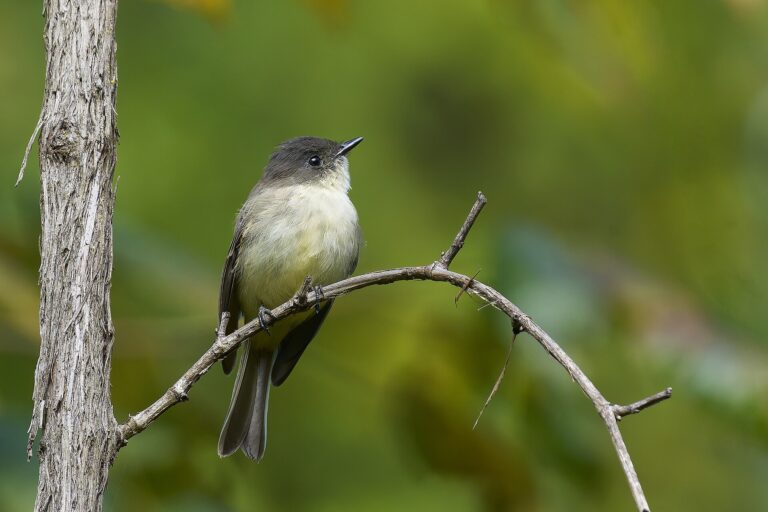
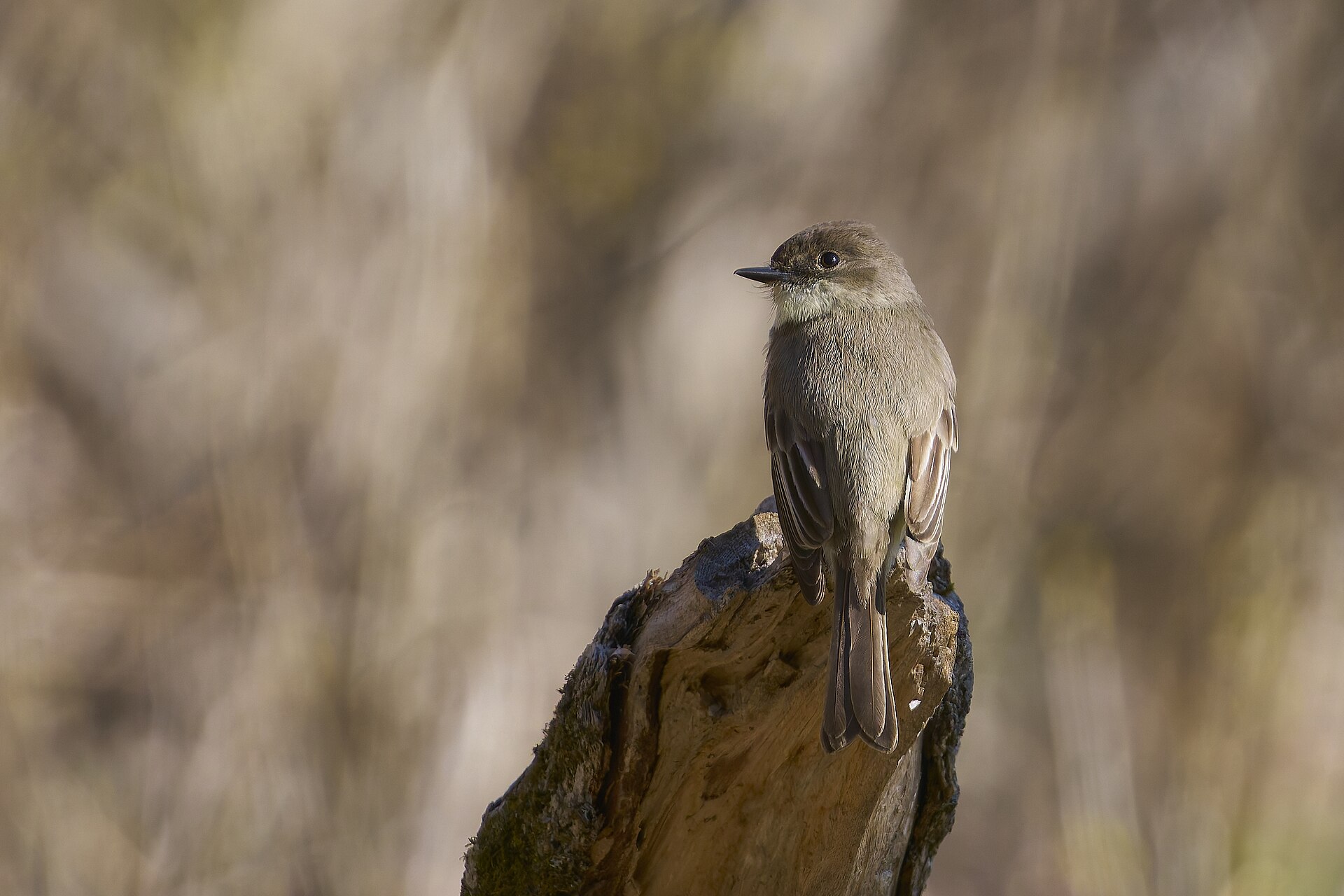
A phoebe’s flick is often described as ‘nervous’ or ‘jerky,’ distinct from the more fluid wagging of other species. Phoebes, particularly the Eastern Phoebe, typically lack a strong eye-ring and have a uniform gray-brown plumage with a paler belly. The combination of plumage, vocalization, and the specific style of tail flicking is the most reliable way to confirm a phoebe’s identity.
The Black Phoebe, found in western North America, is almost entirely sooty black with a white belly, while the Say’s Phoebe has a grayish-brown head and back with a rusty belly. Despite these color variations, the tail flick remains a consistent behavioral trait across the genus.
Additional Resources and Further Exploration
To deepen your understanding, consult authoritative sources. The Cornell Lab of Ornithology’s All About Birds website offers detailed species accounts, vocalizations, range maps, and behavioral insights. eBird lets you explore local sightings, contribute your own observations, and learn about bird distribution.
Regional field guides provide tailored information on local phoebe populations, while books on avian behavior offer broader theoretical frameworks. Engaging with local birding clubs or online forums lets you share observations and learn from experienced birders.
Conclusion: The Enduring Mystery and Charm of the Phoebe’s Tail Flick
The seemingly simple act of tail flicking is, in fact, a multifaceted behavior vital to communication, territoriality, courtship, and potentially foraging efficiency and predator avoidance. Far from being a mere tic, it is a dynamic, context-dependent signal offering a rich tapestry of information about the bird’s internal state.
For birders, recognizing this behavior enriches the observation experience, transforming a casual glance into insight into the complex social lives of these familiar flycatchers. Pairing the visual cue of tail flicks with other body language, vocalizations, and environmental factors unlocks a wealth of understanding.
So the next time you encounter a phoebe, take a moment to appreciate the subtle language of its tail flick. Keep observing, keep questioning, and every flick will tell a story you can begin to read.
