
Introduction: The Enigma of the Black Bird
Large all-black birds are a common but confusing sight: true blackbirds, grackles, crows, and ravens all share dark plumage, yet they are very different species. A quick glance might suggest a generic ‘black bird,’ but a closer look reveals subtle differences in size and body shape, vocalizations, and behavior. This guide gives beginners the practical tips to identify each one confidently during your birding outings.
Understanding the Avian Lineage: More Than Just Black Feathers
These birds belong to different families. True blackbirds like the European Blackbird (Turdus merula) are thrushes (Turdidae), known for melodious songs. In North America, ‘blackbird’ usually means icterids such as the Red-winged Blackbird, while grackles (genus Quiscalus) are also icterids, distinguished by iridescent plumage and long tails. Crows and ravens are corvids (Corvidae), a family renowned for its intelligence and adaptability. Understanding these relationships explains why a thrush’s song is melodious while a grackle’s call is harsh.
The First Clue: Size and Overall Proportions
Size is the fastest first clue, though it requires careful estimation. Compare the bird to a familiar neighbor – is it roughly the size of a robin, a pigeon, or a hawk?
| Bird Type | Approximate Length (Head to Tail) | Approximate Wingspan | Key Size Impression |
|---|---|---|---|
| Blackbird (e.g., European Blackbird, Red-winged Blackbird) | 7-11 inches (18-28 cm) | 12-16 inches (30-40 cm) | Small to medium songbird, robin-sized or slightly smaller. |
| Grackle (e.g., Common Grackle, Great-tailed Grackle) | 11-18 inches (28-46 cm) | 14-23 inches (36-58 cm) | Medium to large songbird, pigeon-sized or larger, notably long tail. |
| Crow (e.g., American Crow, Fish Crow) | 16-21 inches (40-53 cm) | 33-39 inches (84-99 cm) | Large, robust bird, noticeably bigger than a pigeon. |
| Raven (e.g., Common Raven) | 22-27 inches (56-68 cm) | 45-56 inches (114-142 cm) | Very large, hawk-sized or larger, the biggest of the four. |
Practical Example: A black bird perched on a wire that is roughly robin-sized is likely a blackbird. If it is roughly the size of a Red-tailed Hawk soaring overhead, it is almost certainly a raven. Something in between – larger than a robin but not hawk-sized – could be a grackle or a crow. This first size assessment narrows your options dramatically.
Shape, Structure, and Posture: The Silhouette Speaks Volumes
Overall shape, especially the tail and bill, is a strong identification cue.
Blackbirds
Slender and compact, with a rounded head and a small conical bill suited to seeds and insects. Their posture is upright and alert, and North American Red-winged Blackbirds add distinctive red-and-yellow shoulder patches.
Grackles
Noted for long, graduated tails (central feathers longer than the outer ones) that may look keeled in flight, a strong pointed bill, and a confident strutting walk. The Great-tailed Grackle’s V-shaped tail is especially obvious.
Crows
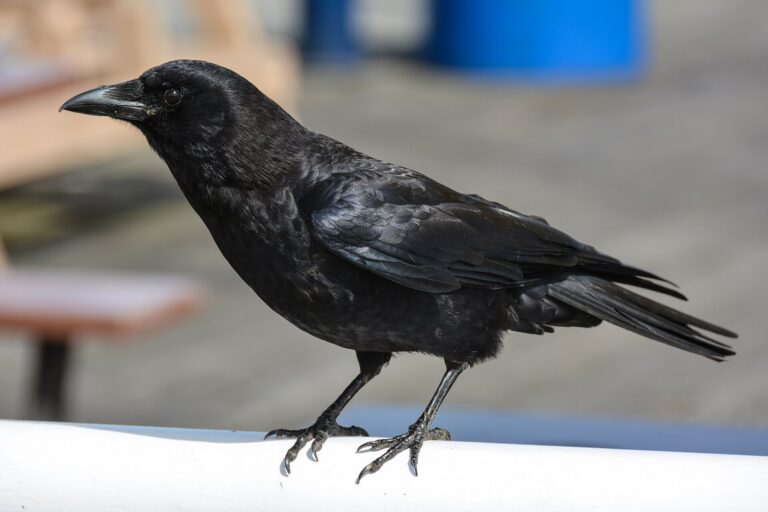
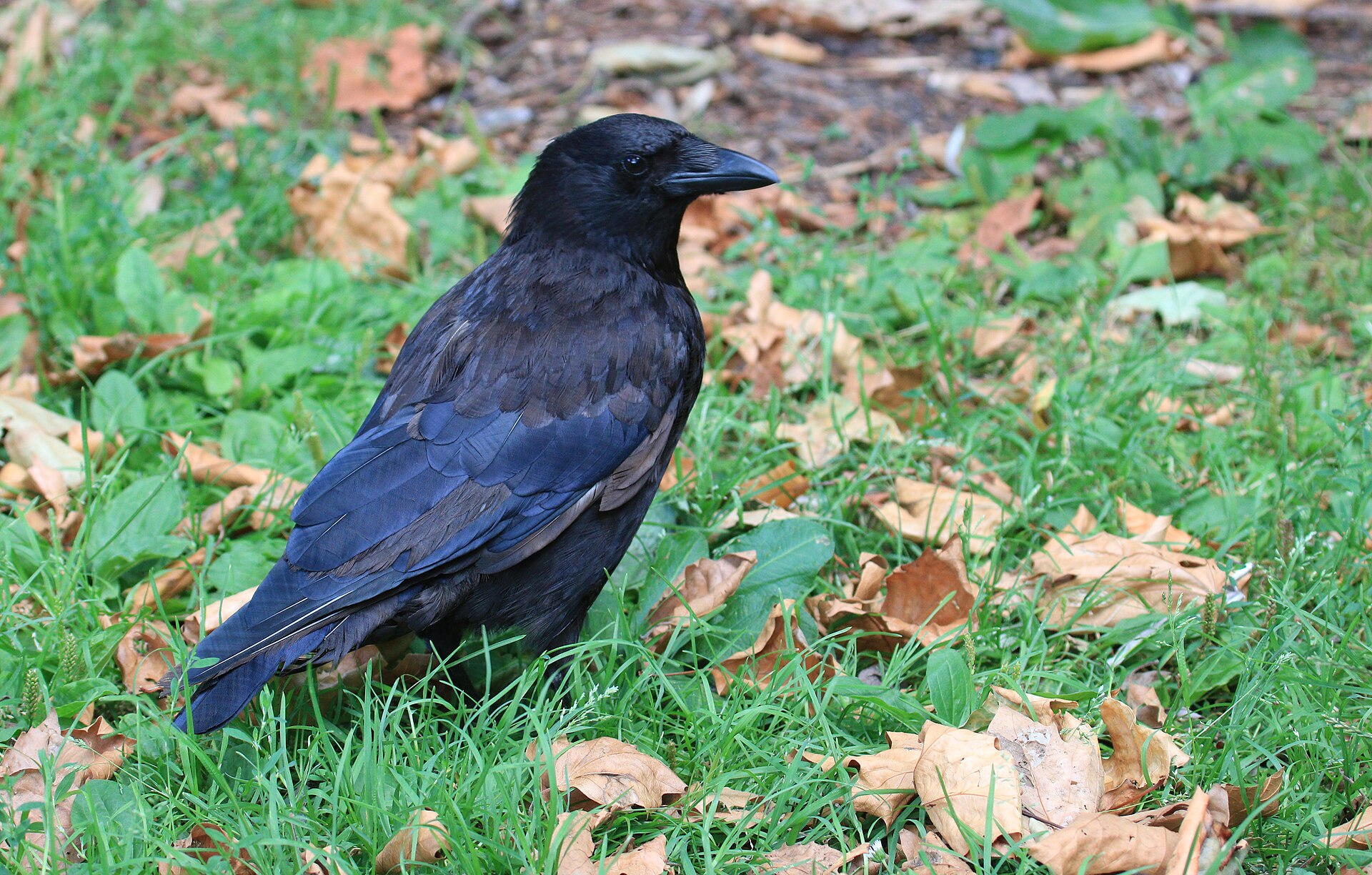
Stocky and uniform, with a large head, thick straight bill, and a fan-shaped or slightly rounded tail. When perched they stand upright with a confident, almost ‘barrel-chested’ stance.
Ravens
The giants, with a massive, slightly decurved bill and shaggy throat feathers called hackles that give a ‘bearded’ look. In flight the tail is distinctly wedge-shaped and they often soar and glide, unlike the crow’s direct flapping.
Field Observation Tip: In flight, a wedge tail means raven; a fan tail, crow; a long, dragging tail, grackle. For perched birds, check bill size and look for the raven’s shaggy throat feathers.
Plumage and Iridescence: The Subtle Spectrum of Black
Good light reveals color and sheen that separate these otherwise similar birds.
Blackbirds
Usually matte black, sometimes with a slight gloss. Red-winged Blackbirds are best told by their bright red-and-yellow shoulder patches.
Grackles
Famous for brilliant blue, green, purple, and bronze iridescence on the head, neck, and back in direct sun, combined with striking pale yellow eyes.
Crows
Uniform glossy black; their sheen is less pronounced and less varied than a grackle’s, and their eyes are dark.
Ravens
Rich, intense, glossy black (sometimes almost blue-black) with dark eyes; the shaggy hackles catch the light and add texture.
Identification Caution: Iridescence depends heavily on light and viewing angle – a grackle in poor light can look dull while a crow in bright sun seems shiny. Treat it as one clue rather than the whole picture.
Vocalizations: Listening to the Language of Black Birds
Calls are often the quickest way to identify these birds, even at a distance.
Blackbirds
True blackbirds sing melodious, flute-like songs, especially in breeding season; Red-winged Blackbirds give a buzzy ‘conk-la-ree!’
Grackles
Harsh, unmusical sounds, such as the Common Grackle’s squeaky ‘squeee-ank,’ described as a ‘rusty gate’; Great-tailed Grackles add whistles, clacks, and gurgles.
Crows
Loud, clear, repeated ‘caw-caw-caw,’ plus rattles and clicks used within their social groups.
Ravens
Deeper, guttural ‘kraa-kraa’ or ‘gronk-gronk,’ plus knocking, bell-like tones, whistles, and even mimicry – a key contrast with the crow’s higher caw.
Practical Example: A clear ‘caw’ means crow; a deep ‘gronk,’ raven; a squeaky ‘squeee-ank,’ grackle; a fluty song, blackbird.
Behavior and Flight Style: How They Move and Act
Movement patterns reflect each bird’s ecological niche and are highly revealing.
Blackbirds
Forage on the ground with quick, agile hops to catch insects or seeds; their flight is direct and undulating with rapid wingbeats.
Grackles
Highly social, gathering in large, noisy flocks and huge communal roosts that can number in the thousands, with a purposeful, strutting walk.
Crows
Live in family groups and communal roosts; fly with steady, rhythmic flapping, rarely soar, and are known to mob and harass larger raptors.
Ravens
Often singly or in pairs; soar and glide like hawks with slow, deep wingbeats, and walk with a deliberate, ponderous gait.
Identification Caution: Individuals can deviate – a crow may occasionally soar and a raven may fly directly – so always combine behavior with other clues.
Habitat Preferences: Where to Look for Each Bird
Where you see the bird narrows the possibilities considerably.
Blackbirds
The European Blackbird favors gardens, parks, and woodlands with dense undergrowth; Red-winged Blackbirds prefer wetlands and marshes where they nest in cattails and reeds.
Grackles
Thrive in open fields, lawns, parks, and urban areas near food from feeders, trash, or crops.
Crows
The most adaptable, found in forests, farmland, suburbs, and city centers, often signaling human activity.
Ravens
Prefer wild, rugged areas – mountains, deserts, and coastal cliffs – with large, undisturbed territories, usually away from dense cities.
Practical Example: A large black bird soaring over a mountain is likely a raven; in a city park, a crow or grackle; a small bird singing in the garden, a blackbird.
Putting It All Together: Practical Field Identification Tips
Good identification synthesizes several clues at once rather than relying on a single feature. Use this systematic approach on your next outing.
- First Impression (Size & Habitat): note the bird’s size relative to known birds, and where you are – forest, urban park, or open field.
- Binoculars Up (Shape & Plumage): slender with a long tail (grackle), stocky (crow), or massive with a heavy bill (raven)? Look for iridescence, hackles, or shoulder patches.
- Listen Closely: deep croak (raven), caw (crow), squeak (grackle), or song (blackbird)?
- Observe Behavior: soaring (raven), steady flaps (crow/grackle), or hopping (blackbird)? Alone, paired, or flocked?
- Consider the Context: time of year, other birds nearby, and regional species such as the smaller Fish Crow.
- Don’t Rush: take your time and cross-reference the features you gather.
Example Scenario: High in the mountains you spot a very large black bird soaring on thermals with a wedge-shaped tail, calling a deep ‘kraa-kraa.’ The size, tail shape, soaring flight, and croak together point to a Common Raven. In a suburban backyard, a medium black bird with a long V-shaped tail struts across the lawn, flashing iridescent blues and greens, then squeaks – a Common Grackle.
Regional Variations and Species Diversity
Each name covers many species. In North America, ‘blackbird’ usually means icterids like the Red-winged or Brewer’s Blackbird, distinct from the European Blackbird (a thrush). There are also several crows (American, Fish, Northwestern) and two main ravens (Common, Chihuahuan) in North America, each with subtle differences in size, call, or habitat. Always consult a field guide specific to your region.
Advanced Tips for the Keen Birder
For finer distinctions, pay attention to these subtle details.
Bill Shape and Size
Ravens have proportionally much larger, thicker bills than crows, giving the head a more massive appearance; grackles have a slender, slightly decurved bill; blackbirds a small conical bill.
Primary Feather ‘Fingers’
In flight, ravens show splayed ‘fingers’ at the wingtips from separated outer flight feathers; crows’ wingtips look blunter and more rounded.
Wingbeat Rate
Ravens beat slower and deeper; crows beat more rapidly and shallowly – a useful cue at a distance.
Social Structure
Crows gather in large, boisterous groups and communal roosts; ravens are more often solitary or in pairs, though they may gather at abundant food sources.
Eye Color
Crows and ravens have dark eyes; many grackles and male Brewer’s Blackbirds have pale yellow eyes, a distinctive feature up close.
Conclusion: The Art of Discernment
By systematically observing size, shape, plumage, vocalizations, behavior, and habitat, you can confidently tell blackbirds, grackles, crows, and ravens apart – and appreciate the unique intelligence and ecological role of each. Practice makes identification intuitive, so carry a regional field guide, use binoculars, and take notes. Happy birding!
